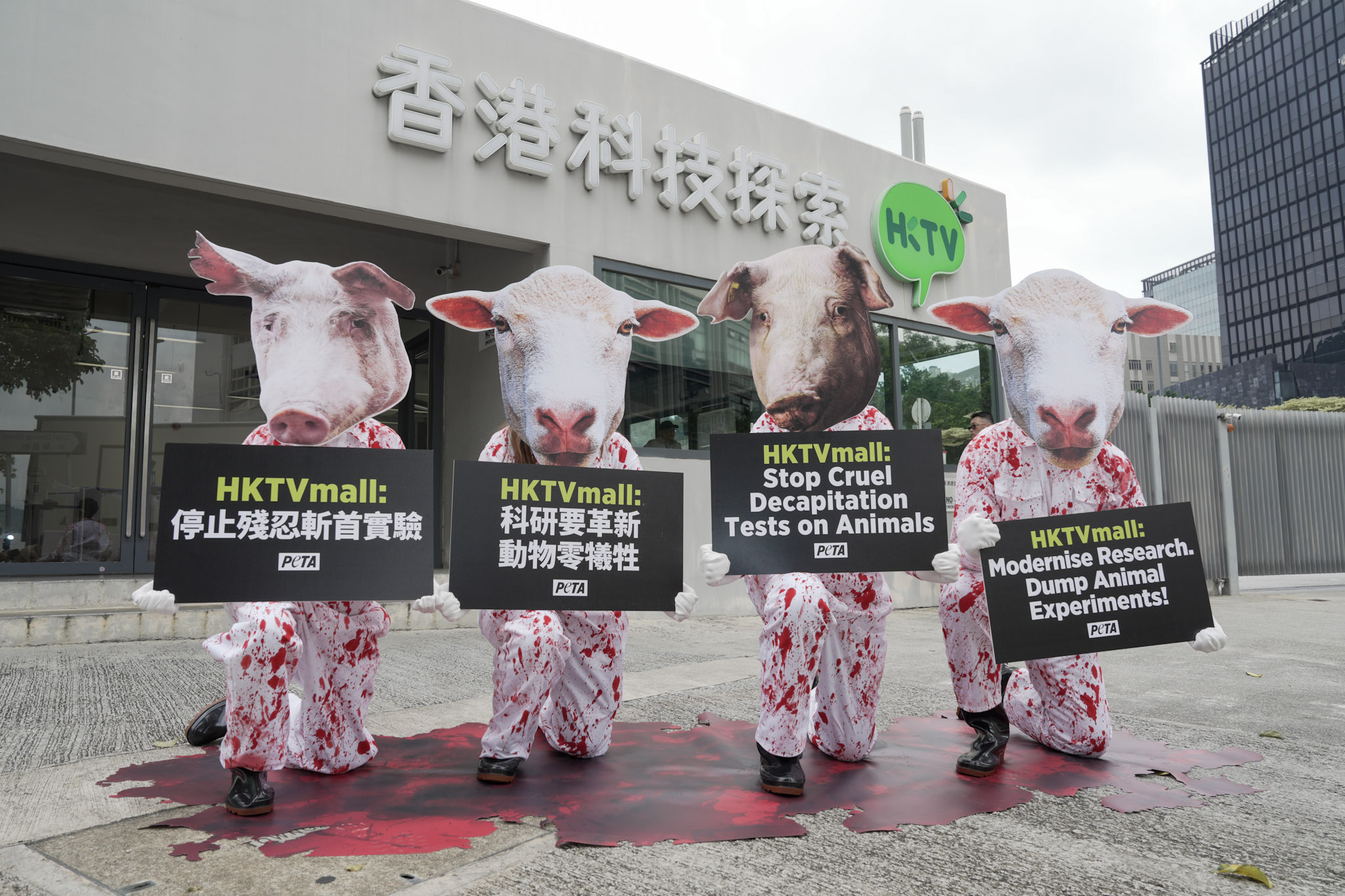
[Above: PETA Asia protests outside the HKTV office building on April 10th, with volunteers dressed in blood-stained clothing resembling pigs and sheep decapitated in animal experiments, condemning the company’s “outrageous” cruelty and disrespect for life. Protestors strongly urge the company to immediately cease the experiments, switch to cutting-edge international non-animal research methods, and call upon the public to boycott HKTVmall online shopping until the company stops animal experiments.]
Excerpt:
HKTV’s animal experiments of severing the heads and limbs of pigs and sheep to observe the survival time of detached organs as research for exploring human health have triggered consumer objections and boycotts, and also cost the company’s lavish spending without promising returns. Yet, that has not stopped the animal experimentation. The lack of animal welfare in Hong Kong’s CSR regulations and culture prompts reflection on how the relationship between humans and animals should be.
________________________
The parent company of the Hong Kong major online shopping platform HKTVmall, Hong Kong Technology Venture Company Limited (“HKTV Group”), announced in late March its 2025 performance, so honestly or even blatantly revealing that it had conducted life science research over the past four years, carrying out 38 animal experiments in two overseas countries. The experiments involved cutting off limbs and heads from pigs and sheep to observe how long the organs could survive after removal from the body, aiming to help develop technologies for long-term preservation of human organs and limb transplantation that could potentially lengthen human lifespan. This sparked significant public outcry, with accusations of animal cruelty. Many HKTVmall’s online shoppers left messages saying they would boycott the store. The company’s annual report revealed the high cost of the experiments, contributing to the company’s HK$150 million loss. However, the unfavorable market reaction and financial losses do not seem to have deterred the company from continuing the experiments.
“The standard of human civilisation: whether or not one has compassion for weaker creatures.”
The core issue of the incident is perhaps how today’s society and global trends view the relationship between humans and animals. Is the value of animals only confined to serving humans, and can they be treated arbitrarily in the name of human well-being? Do animals possess an independent life value that deserves respect and kindness? Many renowned figures have said that how a person treats animals reflects their morality and character. Mahatma Gandhi is often quoted as saying, “The greatness of a nation and its moral progress can be judged by the way its animals are treated.” The German philosopher Immanuel Kant also remarked, “He who is cruel to animals becomes hard also in his dealings with men. We can judge the heart of a man by his treatment of animals.”
Therefore, concerns for how companies treat animals are gradually gaining global attention, and kind treatment for animals has increasingly become part of Corporate Social Responsibility (CSR) in recent years. Today’s commercial culture increasingly demands that companies assume CSR and its implementation is anticipated to be disclosed to benefit a company’s reputation and hence commercial interests. In Hong Kong, listed companies like HKTV are required to submit reports on their CSR practices.
Global Trend: Humane treatment of animals incorporated into CSR efforts
The traditional CSR disclosure usually focused on reporting labor rights and environmental measures, but now it is a global trend to add content on “animal welfare”, particularly in the food, garment and cosmetics industries. For example, the website of Swire Hotels in Hong Kong, while not directly mentioning “animal welfare” when outlining its “sustainability” initiatives, points out that it uses only cage-free eggs in its ingredients. British fashion brand Stella McCartney has stopped using animal leather, fur or skin, opting instead for “cruelty-free” plant-based leather. The cosmetics industry, has been criticised for relying on animal testing for new products, while some major brands in recent years have long abandoned animal testing in favor of alternatives. For instance, L’Oréal stopped using animals to test product safety as early as 1989, replacing it with “reconstructed human skin”. EU countries including the UK have completely banned animal testing for cosmetics.
So in Hong Kong, if investors or consumers disagree with HKTV’s animal experiments, can they demand humane treatment of animals as the company’s CSR practices? Theoretically, yes, but in practice, it may not work, and also highly dependent on the social and cultural atmosphere.
Hong Kong’s CSR regulations and culture: Zero concern for animal welfare
As a listed company, HKTV is required to comply with the rules of Hong Kong Exchanges and Clearing Limited (HKEX) to report its CSR realisation annually. The problem is that HKEX regulations do not explicitly require companies to include animal welfare measures in their CSR reports.
The HKEX-stipulated Environmental, Social and Governance Reporting Codefor listed companies to report on their CSR, focuses on issues like environmental protection, employment policies, labor rights, corporate operations such as anti-corruption and community contribution, but none relates to animals.
On April 24, shortly after releasing its annual report, HKTV published its 2025 ESG Report required by HKEX, outlining the risks and preventative measures taken in 19 identified ESG areas, representing a report on CSR implementation. However, none of the 19 areas specifically addresses animal concerns.
In this respect, Hong Kong’s CSR culture has virtually no reporting requirements for animal welfare.
Massive exodus of HKTVmall customers who boycott the company by deleting its app in protest against experiments cutting off heads of pigs and sheep for medical research
However, the company states on its website that it is “very concerned about the rights and well-being of all animals”, citing examples limited to forming volunteer teams to help out at animal adoption centres doing cleaning jobs, feeding and caring for the animals residing there.
It is hard for a sensible person to imagine that a company claiming to care about all animals’ rights and welfare would deliberately conduct experiments to sever their heads and limbs and observe the survival time of these detached organs, raising questions about whether the animals would suffer prolonged pain before death. The HKTV’s annual report mentioned that based on responses to electrical stimulation, the detached animal heads and limbs could sustain life for a maximum of 7 hours and 46 hours respectively, describing such experiment results are the first of its kind globally, marking a “milestone” – a description subtly reveals a sense of pride.
But the company probably didn’t expect a public outcry followed by severe condemnation from animal rights groups, animal product companies and media KOLs, describing the cruelty as “shocking”. An article from the magazine Esquire even likened the incident to dropping a depth bomb into the calm water of Hong Kong retail market”.
After the news was spread on March 31, many customers of HKTVmall left messages on the online store, accusing the cruelty and expressing boycott. The messages are such as: “Brutal group, forcing animals to bear unnecessary pain in the pursuit of immortality! Boycott! You should close down!” and “I’ve uninstalled the app… thanks to HKTV for its honesty”.
In addition, HKTVmall’s business partner, Pawfect Reborn, a pet health food company, announced on Facebook that all its products had been removed from HKTVmall, citing shock, distress and unease over news reports about the animal experiments, and stated their stance of respect for life.
HKTV response: anesthetics used, alternatives sought; yet public doubts remain
HKTV’s response to the community uproar can summarised in three aspects: (1) The experiments were conducted in accordance with local government regulations and under supervision in the respective countries, and anesthetics were used in compliance with relevant regulations. The experimental team consisted of more than 20 professionals conducting medical research, including neurosurgeons, neurologists, veterinarians, university professors, anesthesiologists and research professionals. (2) The team did explore alternative experimental methods, such as using 3D printing technology for extensive preliminary work in the early stages of the experiment to minimise the use of animals. (3) It claimed that it would adopt a prudent and responsible attitude upon continuing related scientific research projects, and that all necessary experiments would be conducted in full compliance with the standards and regulations of European and American countries. It would continue to seek alternatives as science develops.
Yet, these remarks only met doubts. For example, the animal protection group, PETA (People for the Ethical Treatment of Animals Asia), criticised the information as having “zero” transparency for public monitoring. The company did not specify in its annual report which animals were used in the experiments, revealing the information only after media inquiries, nor did it disclose the number of animals involved or the countries where the experiments were conducted.
Zero transparency means no way to determine whether the experiments comply with regulations and standards
The Virtue Online Journal also inquired with the company via email about the countries and laboratories where the experiments were conducted, but received no specific reply.
If the countries and laboratories involved are unknown, the public has no way of judging the credibility of claims that the experiments were conducted in accordance with local government regulations and under supervision, or whether standards and regulations of Europe and the United States have been followed.
Lots of pigs and sheep set to be sacrificed as experiments continue despite market objections and “burning money” with uncertain returns
Even more worrying is how HKTV clearly stated that the animal experiments hitherto could not be replaced by alternatives because “the research project is a surgical experiment, unlike drugs or cosmetics” and “with today’s medical technology, there are currently no other experimental methods that can completely replace animal experiments”. This indicates that the company’s earlier pledge to seek alternatives to animal experiments has failed to ease concerns. This also means that the practice of live animal dismemberment is set to continue.
Amid public dissent, HKTV did not indicate any cessation of animal experiments; on the contrary, it would continue such practices. The company’s vice chairman-cum-CEO, Ricky Wong Wai-kay, later posted on LinkedIn, explaining that the initial motivation for the animal experiment research stemmed from the illness-related suffering of his elderly family members endured before death. He thus initiated medical research aiming to improve the quality of life for the elderly, and committed to sustaining these efforts.
Meanwhile, one can tell from the company’s annual report that such experiments were a kind of “money-burning” project, with an investment of more than HK$44.5 million over four years that contributed to the Group’s HK$150 million loss last year, but does not guarantee any yields. It says that the research results obtained so far “do not constitute commercial products nor clinically applicable solutions” and there is “no assurance that such outcomes will be achieved in the future”. However, the Group sees “further progress may contribute to broader scientific understanding in life science research”, and it intends to continue investing not less than HK$50 million per annum in the coming years to support further research and development activities, including the setting up of an overseas laboratory. It also explicitly indicates that “extensive repeated experimentations and comprehensive validation will be required before any definitive conclusions can be drawn”. This implies that large-scale animal experiments will persist in the future.
Therefore, the commercial losses incurred from consumer boycotts, group losses and massive investment with uncertain results have not prompted the company to stop the experiments. Hong Kong’s business system and social atmosphere, particularly the constraints and culture of CSR, are not strong enough to force the company to respond to pressure. Perhaps only when money exhaustion caused by the continued experiments or the exodus of consumers leading to profit warnings drives shareholders and investors, who want to protect their interests, to strongly demand a halt to the experiments, will this large-scale bloodbath be stopped.
Animal rights group: animal experiment results for human use unreliable and increasingly dumped as a global trend
The statements released by PETA not only criticised the cruelty of the experiments but also doubted the reliability of applying animal experimental results to humans due to fundamental differences between species. They cited examples of studies examining spinal cord injuries on animals failing to yield significant progress in reviving human spinal neurons, and translation in rats that “has proven notoriously unreliable” for human’s nerve regeneration. Thus, animal experiments have been gradually abandoned internationally.
PETA further cited several alternative technologies that do not require animals for research on improving human health, including organ-on-a-chip technology, organoids, sophisticated computer models, “omics” studies and non-invasive human imaging.
HK rules and relevant academia for CSR neglecting animal concerns which are surely included in Nordic countries though still “instrumental”
As mentioned above, Hong Kong’s CSR regulations show zero concern for animals. This is reflected not only by the codes stipulated by the authority, but also by the promotion of CSR or business ethics in the business schools from universities. For example, Hang Seng University holds an annual “Junzi Corporation” (decent company) election to recognise exemplary enterprises with strong business ethics. However, its “Business Ethics Index” does not include animals. The Virtue Online Journal has reached out to the election department to inquire whether animal welfare elements will be incorporated into the selection criteria in the future, but has not received any reply.
While globally, CSR coverage of animal welfare is still relatively less prominent than other areas such as traditional labor rights, environmental protection or corporate governance like anti-corruption, it is at least mentioned, unlike the near-zero attention in Hong Kong. A 2022 study on how animal welfare was addressed in the CSR reports of 30 largest corporations in the Nordic region indicated that companies using animals as resources would discuss welfare principles for the relevant animal species in their CSR reports. Other companies also considered that animal interests should be acknowledged as corporate competition makes it a demand, although the concern is within an “instrumental” framework that caring for animals benefits nature, the ecology and human health, rather than seeing the intrinsic values of animals who are independent individuals.
Reflection: Do animals possess independent life value deserving respect and kindness?
The issue appears complicated. Although HKTV’s animal experiments met massive opposition, it is not one-sided. There are also voices and comments written on the company’s online shopping Facebook platform that support such experiments for improving human health, stating that the progress of medicine achieved to date has actually relied on past animal experiments.
This in turn goes back to the question raised at the beginning of this article: Is the value of animals merely to serve humans? Do they possess independent life value that deserves respect and kindness?
