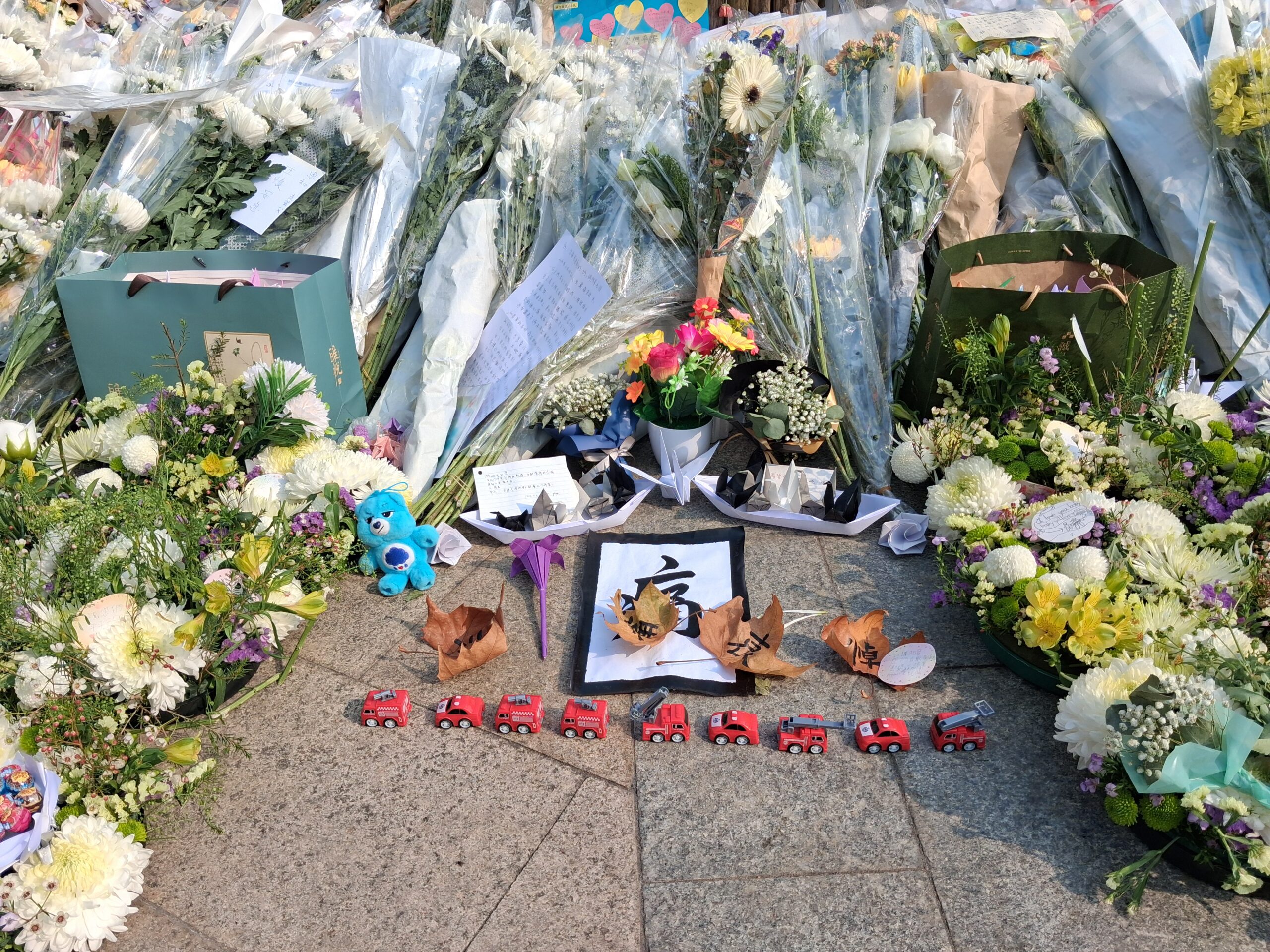
(Photo above: Hong Kong people flocked to the mourning place near the fire incident site Wang Fuk Court to put down flowers, written messages and other memorial items to pay respect to the fire victims.)
(Chinese version of this article. 本文中文版)
Public grief and anger have gripped Hong Kong over the past ten days following a deadly fire that claimed at least 159 lives. Despite the HKSAR government response with multiple relief programmes using a HKD 3 billion fund for temporary housing, basic daily needs, emergency subsidies and other support, the public outrage persists to the extent that national security authorities have began arresting individuals. This analysis explores three key factors contributing to the continuous outcry.
The Hong Kong national security authorities continues to take action against those expressing views on the devastating Tai Po fire that they seem critical of the government. After issuing three statements warning the “external forces with ulterior motives and people who are anti-China and disrupting Hong Kong” against their “smearing the government’s rescue efforts and inciting social division”, the PRC Office for Safeguarding National Security stationed in Hong Kong said on Dec 6 that it had summoned representatives of foreign press, warning them to obey the law as some foreign media outlets “spread false news”, “smear the government’s disaster relief work” and “attack and disrupt the Legislative Council election”.
Three key factors are driving public discontent to persist.
1. Widespread queries about the enforcement of building safety laws and supervision, particularly fire-prevention measures. Concerns had been raised long before the blaze, yet early government comments made after the fire breakout seemed to downplay the concerns to divert attention from the real problems;
2. Suspected collusive bidding in the maintenance works of fire-stricken Wang Fuk Court and questions about the accountability of individuals with public power, including officials and a pro-Beijing district councillor;
3. Government suppression of demands, criticisms and even attempts by citizens to discuss and explore building-safety issues in the construction sector.
Taken together, these issues illustrate how weakened checks and balances in a system dominated by a single political stand have contributed to governance failures—failures that ultimately cost lives.
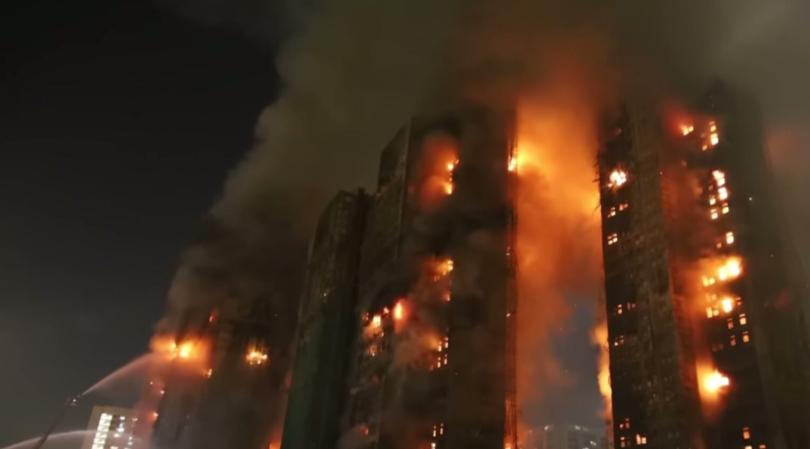
(Photo courtesy: Chinese version of Wikipedia adopting Youtube photo of the Hong Kong media am730)
Below are details of the above three factors.
Factor 1: Early government comments shifted attention to technical issues while leaving the blame of negligence
The fire broke out in the 26 November afternoon with only a small scale of flames but swiftly grew into an uncontrollable blaze within six minutes, sweeping seven high-rise residential buildings of the Wang Fuk Court. Construction professionals interviewed by the media shortly afterwards noted the unusual speed and intensity with which the green protection nets wrapping around the buildings burnt, suggesting the nets were substandard in fire-retardant function.
At midnight—roughly ten hours after the fire began, Security Secretary Tang Ping-keung acknowledged the firefighters had found the building-wrap materials burning far more intensely and rapidly than typical compliant materials, which was unusual and would be investigated. Yet later the same day, the Chief Executive John Lee Ka-chiu spoke about a long-term plan to replace bamboo scaffolding with metal scaffolding, appearing to shift the public focus away from the questionable fire standards of the nets. On the next day (28 Nov), Tang reversed his earlier remarks, saying preliminary tests showed the nets were fire-retardant and attributing the rapid fire spread to foam boards covering the windows. All these remarks came before a thorough investigation had been completed, leaving the public an impression that the government was moving quickly to put the blame onto scaffolding and window foam, instead of the fire safety standard of the nets.
Subsequent investigations by both media and government have revealed that the protective nets—falsely labelled as fire-retardant—originated from Shandong Province in mainland China. This revelation heightened public suspicion over Tang’s early remarks about the compliance of the tested nets.
Long before the tragedy, fire risks, safety law enforcement and regulatory loopholes had been raised by the Wang Fuk Court residents and some individuals monitoring building-safety issues. Construction engineer and political commentator Jason Poon Chuk-hung, had involved in investigating risks at Wang Fuk Court over a year. Along with residents, he conducted flammability tests on scaffolding nets and window-foam boards and found them unsafe. He contacted the Fire Services Department, the Labour Department, and Housing Bureau’s Independent Checking Unit (ICU), but did not receive adequate attention. He suspects official negligence.
Factor 2: A history of suspected collusion and an exorbitant maintenance contract
The fire is a later episode of the concerns about the highly contentious maintenance project at Wang Fuk Court, which cost an astonishing HKD 330 million—equivalent to HKD 160,000–180,000 per household. Residents protested vigorously when the former Owners’ Corporation approved the contract in early 2024, amid widespread suspicion of bid-rigging, a long-standing problem plaguing the construction sector frequently associated with corruption, inflated costs, and compromised maintenance quality.
Since the fire, media investigations have revealed Yet only after massive loss of lives, has the ICAC (Independent Commission Against Corruption) arrested concerned individuals but no people holding public power (e.g. regulatory officials, a pro-Beijing District Board member involved) are investigated so far.
Since the fire, media investigations have revealed that the contractor for the maintenance works, Prestige Construction & Engineering Co. Limited, has a long record of legal violations – at least ten offences related to occupational safety, including three involving scaffolding safety. The Buildings Department had even temporarily barred the company from minor works and ordered fine.
Yet Prestige still won the contract at an extraordinarily high price. Media investigative reports released recently show that the consulting firm, Will Power Architects Co. Ltd, which recommended Prestige while omitting its violation history from the bidding analysis provided to residents.
The exorbitant contract was supported by the long-standing pro-Beijing political party (Democratic Alliance for the Betterment and Progress of Hong Kong, DAB) member, Peggy Wong Pik-kiu, who served as an adviser to the Owners’ Corporation during the tendering process. She had been a district councillor for 12 years in the area and currently serving. She once intervened in the disputes to defend the former OC chairperson during resident backlash over the contract.
Public queries naturally followed.
- Are there any officials to be held responsible? Despite early concerns about fire risks and suspected collusion, did government departments—including the Fire Services Department, Labour Department, Buildings Department, Housing Department, and Urban Renewal Authority—take enough action to prevent disaster?
- Should any officials be held accountable?
- Although ICAC and the police have arrested 21 people—mainly from the contractor, consultant, subcontractor, and fire-equipment supplier—not a single person holding public authority, including officials or district councillor Peggy Wong, has been brought into the investigation.
Factor 3: Dissenting voices are suppressed amid national security actions
While public grief and anger spilled into discussions, criticisms and calls for accountability. China’s Office for Safeguarding National Security stationed in Hong Kong has already issued 4 statements accusing “external forces with ulterior motives and people anti-China and disrupting Hong Kong” of “spreading false information”, “smearing rescue efforts and inciting social division” and “exploiting the disaster to disrupt Hong Kong”. In the meantime, multiple arrests or actions have followed to stop expression of concerns or opinions:
- Chinese University student Miles Kwan was arrested for alleged “incitement” after launching a signature petition raising four demands, including an independent commission of inquiry and holding officials accountable for regulatory negligence”.
- A group of pro-democracy individuals planning a press conference on building maintenance policies, bid-rigging, support for the fire victims and an inquiry committee was called off due to “notification from a department”, and one member preparing to attend was asked to meet the national security police.
- Two netizen having been closely following the incident and have contact with foreign media, Hailey Cheng and Ellie Yuen, announced that they would stop commenting online. Yuen, who released English-language videos about the fire, mentioned “force majeure” for the halt of commentary.
- China’s National Security Hong Kong Office summoned several heads and journalists of foreign news organisations in Hong Kong regarding their “spreading false information, smearing the government’s relief work and attacking the Legislative Council elections”.
- Former vice-convener of the Civil Human Rights Front and political commentator Wong Kok-on was arrested for disclosing details of a meeting summoned by the national security officials and for making seditious remarks that incite hatred towards the Hong Kong government and the central government.
Meanwhile, amid the Legislative Council election campaigns, the current LegCo member for Social Welfare functional constituency, Dr. Tik Chi-yuen, requested an urgent debate on resettlement and assistance for the fire victims—a normal demand or practice in the past, was even rejected by the LegCo president Andrew Leung Kwan-yuen.
All these developments illustrate a governance environment with dissenting voices eliminated. After the 2020 National Security Law and the 2021 electoral overhaul, only “patriots” (i.e. pro-Beijing loyalists) are allowed to run for office. Most democrats, activists and civic groups have either been jailed or silenced. Among them is former lawmaker Lam Cheuk-ting, known for actively campaigning against bid-rigging.
Disaster revelation: A one-voice Hong Kong under Beijing’s “all-round governance” weakening checks and balances vulnerable to tragedies
Under Beijing’s “all-round governance” over Hong Kong, the weakening of checks and balances is a natural consequence that is already seen to be highly related to the fatal fire tragedy.
In a system where only one political stand dominates, what can the public expect in terms of fairness, justice, and responsible governance that truly protects their well-being?
This is why doubts and debates still linger on when the Chief Executive John Lee announced on Dec 2 the setting up of an “independent committee” to review the fire and look into eight issues. Some comments wonder how the committee can manage to find the root causes of the calamity when it does not have legal power to investigate, to compel testimony or to obtain documents. Moreover, while the committee will be chaired by a judge, questions remain over the extent of judicial independence after Beijing’s reiterated stance that all governing personnel—including judges—must be “patriots.”
